

 VI
VI ID
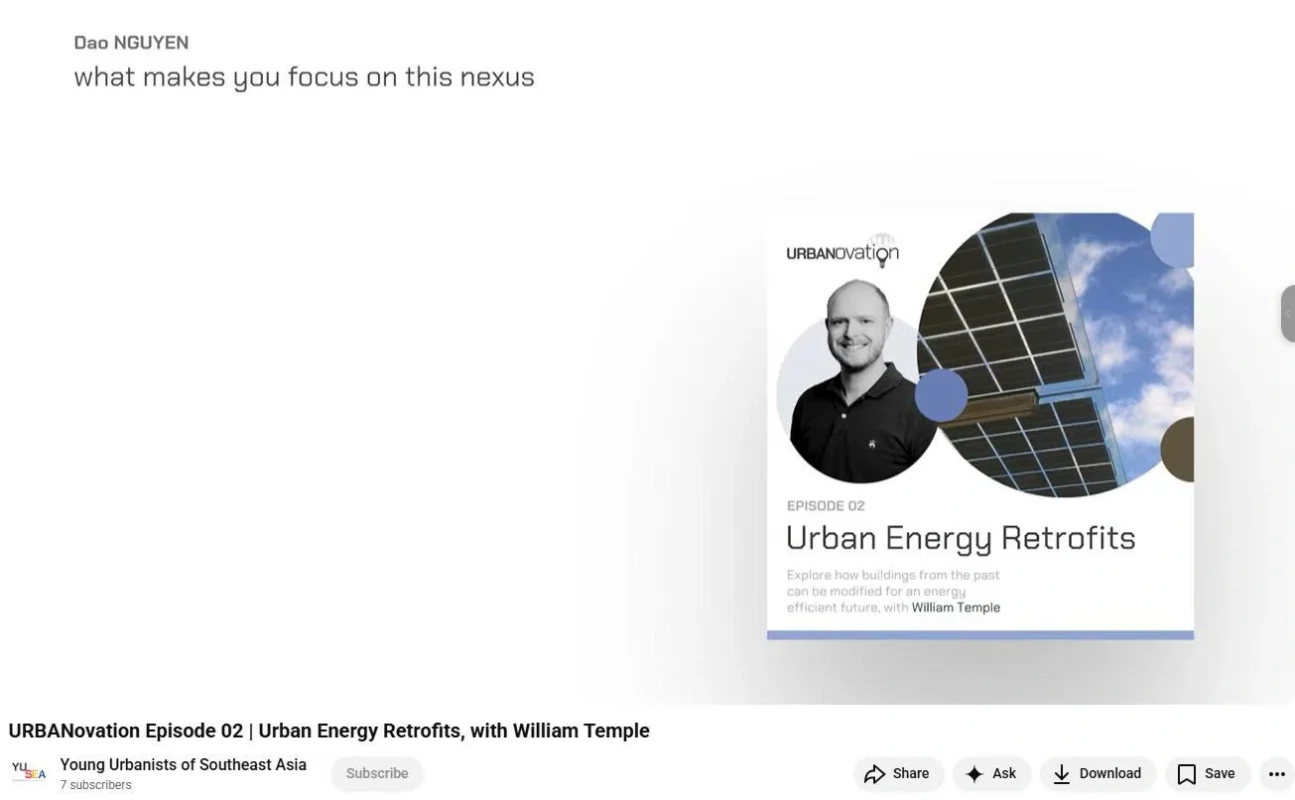
IDURBANovation Episode 02 – Urban Energy Retrofits, with Ampotech
08/04/2025Energy Retrofits: The Real Path to Smarter, More Sustainable Cities
Energy retrofits are quickly becoming the most practical and impactful path toward truly sustainable cities. While conversations about smart cities often highlight futuristic skylines and brand-new urban developments filled with cutting-edge technology, this vision misses a critical reality. Most people will live, work, and spend their daily lives in buildings that already exist. Across Southeast Asia, office towers built in the 1990s, apartment blocks from the early 2000s, and long-standing malls, hospitals, and schools continue to dominate the urban landscape. Many of these buildings remain structurally sound—but they consume far more energy than they should.
Energy retrofits address this gap directly. Instead of waiting decades for old buildings to be replaced by new ones, retrofitting focuses on improving the performance of existing infrastructure today. This approach is essential if cities want to make meaningful progress toward climate goals, reduce emissions, and manage rising energy demand. New developments alone cannot solve the problem fast enough. The real opportunity lies in upgrading what is already built.
One of the reasons energy waste is so common in older buildings is how they were originally designed. Historically, engineers relied on conservative assumptions and large safety margins. Mechanical and electrical systems—especially HVAC and chiller plants—were often oversized to handle worst-case scenarios. While this ensured reliability, it also meant systems rarely operated at optimal efficiency. As buildings aged and usage patterns changed, these inefficiencies became even more pronounced, leading to higher operating costs and unnecessary energy consumption.
This challenge was explored in a recent episode produced by Young Urbanists of Southeast Asia, featuring William Temple, CEO and co-founder of Ampotech. William began his career in mechanical and electrical (M&E) consulting, where he saw firsthand how design assumptions can lock buildings into inefficient energy performance for decades. From office towers to large commercial facilities, he observed that many systems were operating far beyond what was actually needed.
These early experiences shaped William’s belief that the future of urban sustainability depends on smarter energy retrofits. Rather than relying solely on costly and disruptive equipment replacements, modern retrofits use data and technology to align building performance with real-world usage. Sensors, monitoring systems, and digital platforms make it possible to understand how energy is actually consumed—hour by hour, system by system.
Through this data-driven approach, energy retrofits can identify inefficiencies that were previously invisible. Cooling systems can be optimized, equipment schedules adjusted, and performance fine-tuned without compromising occupant comfort. The result is lower energy consumption, reduced emissions, and improved operational reliability—all achieved within existing buildings.
In Southeast Asia, where rapid urbanization has left cities with a vast stock of aging buildings, energy retrofits offer one of the fastest routes to impact. Retrofitting existing infrastructure delivers immediate benefits: reduced energy bills, extended asset lifespan, and measurable progress toward sustainability and ESG goals. For building owners and operators, this means achieving results without the long timelines and high costs associated with new construction.
More importantly, energy retrofits redefine what it means to build a smart city. A smart city is not defined solely by new developments or advanced architecture. It is defined by how intelligently it manages resources across the entire urban environment. By upgrading existing buildings with smart energy solutions, cities can significantly reduce their environmental footprint while improving resilience and efficiency.
As William Temple’s work at Ampotech illustrates, the future of Southeast Asia’s cities will not be built from scratch. It will be unlocked through energy retrofits that transform aging buildings into responsive, efficient, and data-informed assets. This is where real progress happens—not in waiting for the future, but in improving the cities we already have today.
Try Ampotech
Contact our team to experience Ampotech’s energy solutions firsthand.